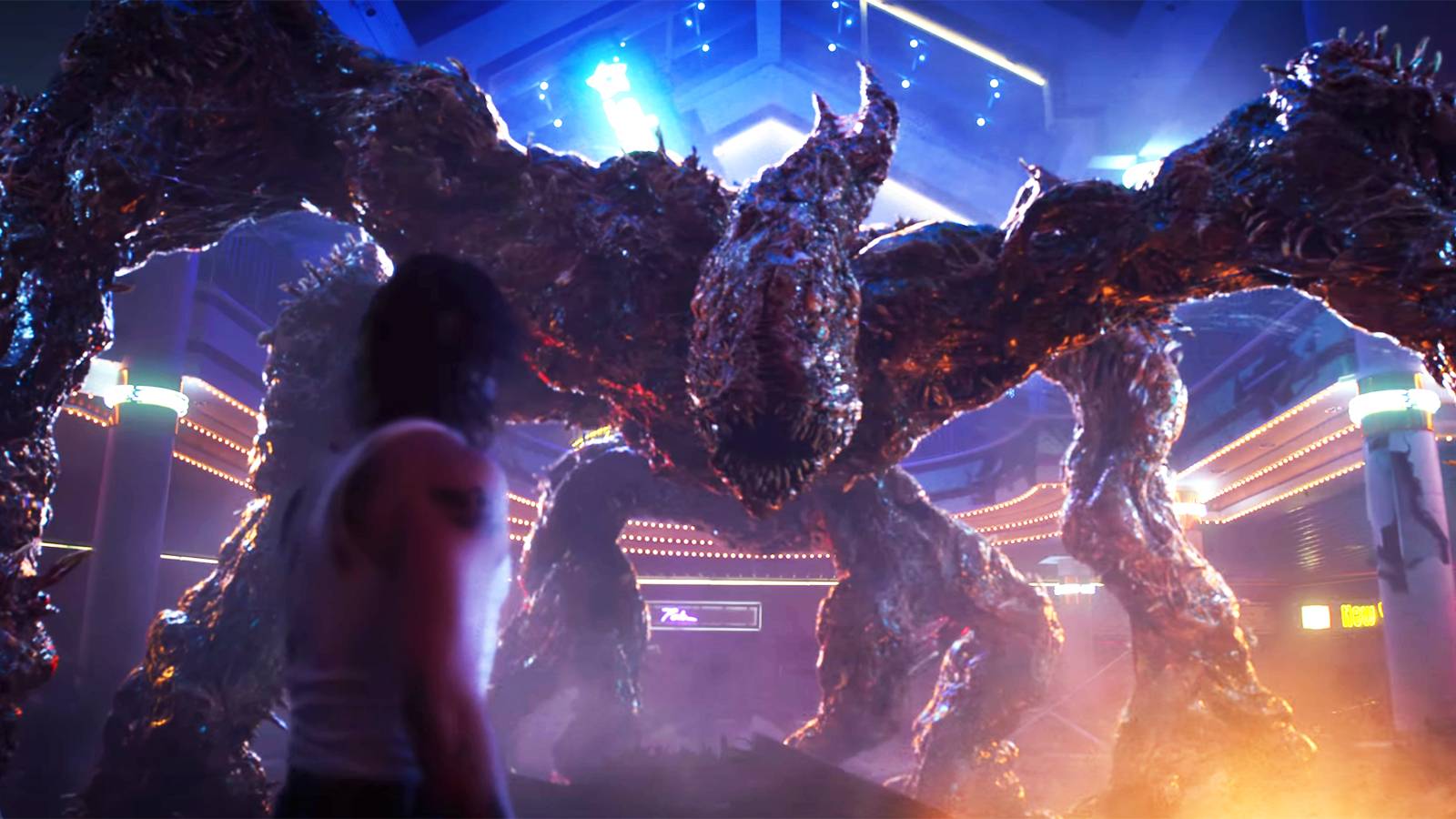
WHY DID MIND FLAYER APPEAR IN A PHYSICAL FORM ONLY TO BE QUICKLY DEFEATED IN THE FINAL BATTLE? As the curtain closed on season 5, besides the visual spectacle, many “Hawkins residents” felt disappointed by the rather swift downfall of the new “god” of The Abyss. An ancient entity, a multidimensional conqueror, why did it choose to manifest in a physical body only to be defeated so quickly? Was this a writer’s mistake or a logical flaw? Is there a chance that the Conformity Gate theory will resolve the entire story? The answer is no. If we examine the entire journey from Season 1 to Season 5 through the lens of strategic and bio-fictional elements, we’ll see that this failure wasn’t a coincidence, but the inevitable consequence of a risky evolutionary gamble that Mind Flayer was forced to take. Throughout the series, we’ve always believed that Mind Flayer was merely a spiritual entity, existing in the form of a cloud of particles and only borrowing the image of the giant spider sculpted by Vecna ​​in his mind to intimidate. He never actually appeared in flesh and blood, with the sole exception of Season 3. But why this change? As I analyzed in my previous article on the spiral time theory, Season 3 was a “discordant note” in Hawkins’ dark symphony. Because the Russians deliberately used machinery to forcibly open the portal in July, a time when Earth and Dimension X were not aligned, Mind Flayer couldn’t bring his evil entity through the portal between the two worlds as planned. He was forced to utilize the “aftermath,” the remaining particles from Season 2, to improvise. And that’s how “The Meat Flayer”—the monster pieced together from rat meat and human corpses—came into existence. However, Mind Flayer is clearly an ancient entity and a brilliant strategist. The events of Season 3, though ending in collapse, were the perfect “demo” of his physical prowess. In fact, the meat monster (The Meat Flayer) from that year wasn’t weak at all; on the contrary, it was a nearly indestructible machine of destruction, capable of reassembling countless times from fragments and almost immortal. The only thing that could defeat it wasn’t human firepower, but its “disconnection” when the portal closed. And this unfinished demo, this failure, taught Mind Flayer a costly lesson: the physical body is the ultimate weapon, but dependence on “signals” from the artificial portal is its Achilles’ heel. Therefore, he secretly devised a plan to gamble on evolution. From that moment, Mind Flayer realized that simply manipulating minds remotely wasn’t safe enough to invade the real world. He craved the overwhelming physical power of season 3, but at a higher level: a complete, autonomous body, no longer a makeshift patchwork of flesh. And Mind Flayer’s “disappearance” throughout season 4 and the beginning of season 5 was the gestation period for that entire plan. He was hiding, synthesizing a Giant Spider body with an impenetrable exoskeleton. And this is where the roles of the 12 children were fully revealed. They weren’t just “anchors” for folding space, but also perpetual “biological batteries” for this colossal body. The pure energy from them was the fuel source maintaining that physical body, allowing him to rampage through the real world without fear of being “shut down” again. The theory was perfect, but the reality of the battlefield was far more brutal. A closer examination of the technical details of the final battle reveals that Mind Flayer’s defeat was the result of an interrupted “battery charging” process and core weaknesses in the Hive Mind system. The first cause stemmed from the forced awakening of a “semi-finished product.” Vecna’s plan was to use 12 children to fully charge the monster’s energy, turning it into an immortal fortress to hide inside before unleashing it. However, the interference of Hawkins’ group, especially unexpected “variables” like Derek and Holly, disrupted the energy flow. As a result, the Mind Flayer was forced to “awaken” in a state of energy starvation. It was like a super-powered machine being forced to start when the fuel was only half full. And because of this lack of sustaining energy, its physical exoskeleton, though sturdy, lacked the “super-healing” ability—the immortal power that The Meat Flayer possessed. More fundamentally, this failure stems from a paradox of evolutionary biological complexity. Why is the Meat Flayer, made from scraps of meat, more resilient than the Spider, made from advanced matter? The answer lies in the fact that the Season 3 monster had a simpler structure, just a chaotic mass of biomass, making reassembly easy: wherever it crumbles, it’s replaced with flesh. Conversely, the new body in Season 5 is a complete organism with a complex skeleton, crustaceans, nervous system, and even a heart that Vecna ​​can connect to from within. And the more sophisticated a machine is, the more prone it is to failure if it lacks energy. When the power supply is cut off, this complex body no longer has enough “electricity” to maintain that advanced biological structure, causing it to lose the endless regenerative ability of its predecessor. And the final blow that ended Vecna’s ambitions was the deadly “communicating vessels” effect of the symbiotic bond. In the final battle, Vecna ​​and Mind Flayer didn’t operate independently, but instead chose to cooperate, with Vecna ​​acting as the “charger” and central brain (CPU). When El attacked with full force and “pinned” Vecna, she not only directly hit the system’s processor, weakening Vecna, but also inadvertently cut off the control signals and power supply to Mind Flayer. As a result, despite its massive physical body, Mind Flayer became sluggish and disoriented due to the loss of power. Conversely, when Mind Flayer’s physical body was destroyed, the feedback shock rebounded onto Vecna, paralyzing him completely. In short, the final defeat wasn’t a logical flaw of the directing duo, but rather the price Vecna ​​paid for his arrogance. He desired a perfect body, a perfect connection, but that very close connection was the real problem. This turned them both into a domino effect: if one piece was shaken, the entire divine system would collapse instantly. It’s unclear what Vecna ​​whispered into Mind Flayer’s ear, but it’s clear the evolutionary plan they were both betting on had met a swift and complete failure.

The Mind Flayer’s Powers In Stranger Things Explained
Stranger Things season 3 Mind Flayer

The Mind Flayer is one of the more dangerous villains that Stranger Things has introduced — save for Vecna in season 4. The evil entity, also referred to as the Shadow Monster, made its debut in the Netflix show’s second season. After wreaking havoc on the citizens of Hawkins, it returned in Stranger Things season 3, albeit in a different form. The Mind Flayer harbored significant powers, and many of those abilities were on display when battling the show’s plucky human heroes. As it turned out, season 1’s Demogorgon was just one creature that resided in the Upside Down. Though it was a serious threat on its own, the species was actually controlled by the Vecna.

The supreme leader pulled the strings when it came to any living matter that came from the dark dimension. Unfortunately, it also held abilities that could affect those living outside the Upside Down — something that Will Byers learned quickly. Stranger Things season 4 saw the king of the Upside Down, Vecna, come to light as the series’ titular Big Bad. The latest installment also helps put more of the Mind Flayer’s powers into context, as it was revealed that Vecna was in control of the monster the whole time. While the Mind Flayer boasts some serious abilities, none of them would be possible without Vecna himself. Here are all the powers Stranger Things‘ Mind Flayer has explained.

Hive Mind

Stranger Things Demogorgon and Mind Flayer

When the Mind Flayer was introduced in Stranger Things season 2, it presented one of the monster’s most distinct abilities: the hive mind. As the ruler of the Upside Down, Vecna had full control over the creatures from the other dimension, including the Mind Flayer. Aside from the Demogorgon, Vecna was able to command the army of Demodogs to specific locations throughout Hawkins. When its connection with Will was made, the Mind Flayer had control over his mind, but on the flip side, he could hack into the monster to gain key insight into its weaknesses.

Human Possession

Will Billy and the Mind Flayer in Stranger Things Season 3

For the Mind Flayer’s hive mind to work, the monster must infect an individual. In doing so, the victim would act as a host body for the Mind Flayer’s possession. This occurred with both Will and Billy Hargrove, causing the characters to serve as spies in the primary dimension. By infecting and possessing other humans within Hawkins, the Mind Flayer was able to build a Flayed army. It was then able to control the army through the hive mind, making the monster even more dangerous. The only known way to stop the possession, and the hive mind, would be to burn the Mind Flayer’s essence out with extreme heat.

Biokinesis

Mind Flayer's Creature Stranger Things

Before Eleven closed the Gate in season 2, a piece of the Mind Flayer that infected Will was left behind in Hawkins. When the new Gate was opened under Starcourt Mall, the Mind Flayer was able to control its remains from the other dimension to infect rats. Those rats then melted into biomass that formed together to create a proxy body. As the Mind Flayer took control of more humans, they too were melted and absorbed into the proxy form. The creature then evolved into the Hospital Monster and Spider Monster through biokinesis, before growing into its full form.

Power Absorption

Eleven Losing her powers

In Stranger Things season 3, the Mind Flayer attacked Eleven and her friends at Hopper’s cabin. Despite her own powers, Eleven was bitten by one of the monster’s tentacles, leaving a piece of it embedded in her leg. The injury weakened Eleven’s powers until they disappeared altogether. Even months after the group defeated the Shadow Monster, Eleven was still without her special abilities. Somehow, the Mind Flayer was able to absorb her powers after it bit her.

Atmospheric Control

Stranger Things 3 Trailer - Eleven on the Beach

Each time Will envisioned the Mind Flayer in Stranger Things season 2, the monster was surrounded by large stormclouds and red lightning. The same type of weather was shown when the Mind Flayer loomed over the middle school during the Snow Ball and when Eleven got an insight into Billy’s childhood on the beach. The atmospheric control remained within the Upside Down, but the weather change seemed to have a connection to the Mind Flayer’s emotions.

Vecna is Controlling the Mind Flayer

Vecna stares at the camera Stranger Things 4

It came to light in Stranger Things season 4 that the Mind Flayer was actually formed from dust by the villain Vecna/Henry Creel/One. The powerful psychic is truly the one that has been controlling the Mind Flayer the entire time, meaning that he is the one who is capable of maintaining a hive mind, human possession, atmospheric control, biokinesis, and power absorption. The Mind Flayer is simply Vecna’s puppet, doing as its master says and wishes. He created the creature out of a dark cloud of dust so that it would form the iconic betentacled form of the Mind Flayer that only he can control, transforming nondescript particles into a formidable foe with incomparable psychic abilities. Not only does he control the Mind Flayer, but he also controls every creature that has emerged from the Upside Down — making him Stranger Things‘ most powerful villain.

Related Posts