Film Review “Bridgerton” Season 4: A Cinderella Romance and the Miracle Called Dignity
After three seasons of offering viewers an escapist fantasy through lavish balls, emotionally rich storytelling, and romances tinged with fairy-tale allure, Bridgerton enters its fourth season with a more grounded perspective. The series does not abandon the opulence that has become its signature, but it begins to pose more direct questions about the reality that always exists beneath silk gowns and candlelight: where does love lead when two people stand on completely different social rungs?
Season 4 of Bridgerton centers on Benedict Bridgerton, the family’s second son — a character long portrayed as a dreamer who lives more by inspiration than obligation. Alongside him is Sophie Baek, a new face who carries the familiar silhouette of Cinderella, but rewritten with a more realistic spirit, fewer miracles, and far more tangible consequences. Their encounter unfolds into a love story that confronts inequality in status, privilege, and the limits of personal choice, rather than revolving solely around beautiful, fairy-tinted emotions.

Bridgerton Season 4: A Masquerade Ball and the Beginning of a Fleeting Dream
The opening of Season 4 brings audiences back to a masquerade ball — a familiar setting within the world of Bridgerton. Under silver light and behind masks, Benedict encounters a woman who immediately pulls him out of his familiar rhythm of life. Those first stirrings, those euphoric emotions, do not last long.

When the night ends, the mask falls along with the truth of Sophie’s identity. She does not belong to a world Benedict can freely enter and leave. Sophie exists within it like a shadow — a laborer bound by rules far harsher than the etiquette governing the aristocracy. From this point on, the ball is no longer a gateway to a fairy tale, but a fragile, beautiful memory — one that could cost a woman the little security she possesses.
Dignity as Love’s Ultimate Test
The most significant difference in Season 4 lies in how Sophie is written. While traditional Cinderella figures are often granted magic to escape their fate, Bridgerton’s Sophie is not afforded that luxury. She is gentle and capable of deep love, but she also has firm boundaries when it comes to dignity. Sophie understands that affection, no matter how sincere, cannot compensate for an imbalance of power.
This character is written with many moments of silence. Sophie does not constantly recount her suffering, nor does she turn trauma into justification. It is precisely this silence that makes her convincing. Every choice Sophie makes carries risk, and she is acutely aware of it. In a world where status nearly determines everything, holding onto self-respect becomes the bravest act of all.

Yerin Ha’s performance plays a crucial role in giving Sophie depth. She brings just enough fragility to evoke empathy, without ever rendering the character weak. The moments when Sophie refuses what seems most tempting are precisely when she appears most defined and powerful.
Though he is the central character of Season 4, Benedict does not require a dramatic transformation. His appearance and demeanor retain their familiar free-spirited quality. His change unfolds quietly and subtly, within his thoughts and inner life. Benedict loves Sophie with the intuition of an artist drawn to beauty, sadness, and an unnamable sense of familiarity. Yet he possesses something Sophie does not: the power of choice.
This difference forms the core conflict of the season. Benedict is neither selfish nor cruel. He is sincere, passionate, and believes his feelings are strong enough to overcome barriers. However, at a crucial moment, he makes an offer that reveals he still views the world from a position of privilege. That moment is uncomfortable, even controversial, but necessary to heighten the drama and expose the gap between good intentions and real-world consequences.
Notably, Season 4 does not attempt to excuse Benedict, nor does it place the burden of understanding on Sophie. Instead, the narrative forces the male lead to confront a larger question: is love powerful enough to change how a person uses their privilege?
A More Restrained Approach to Intimacy
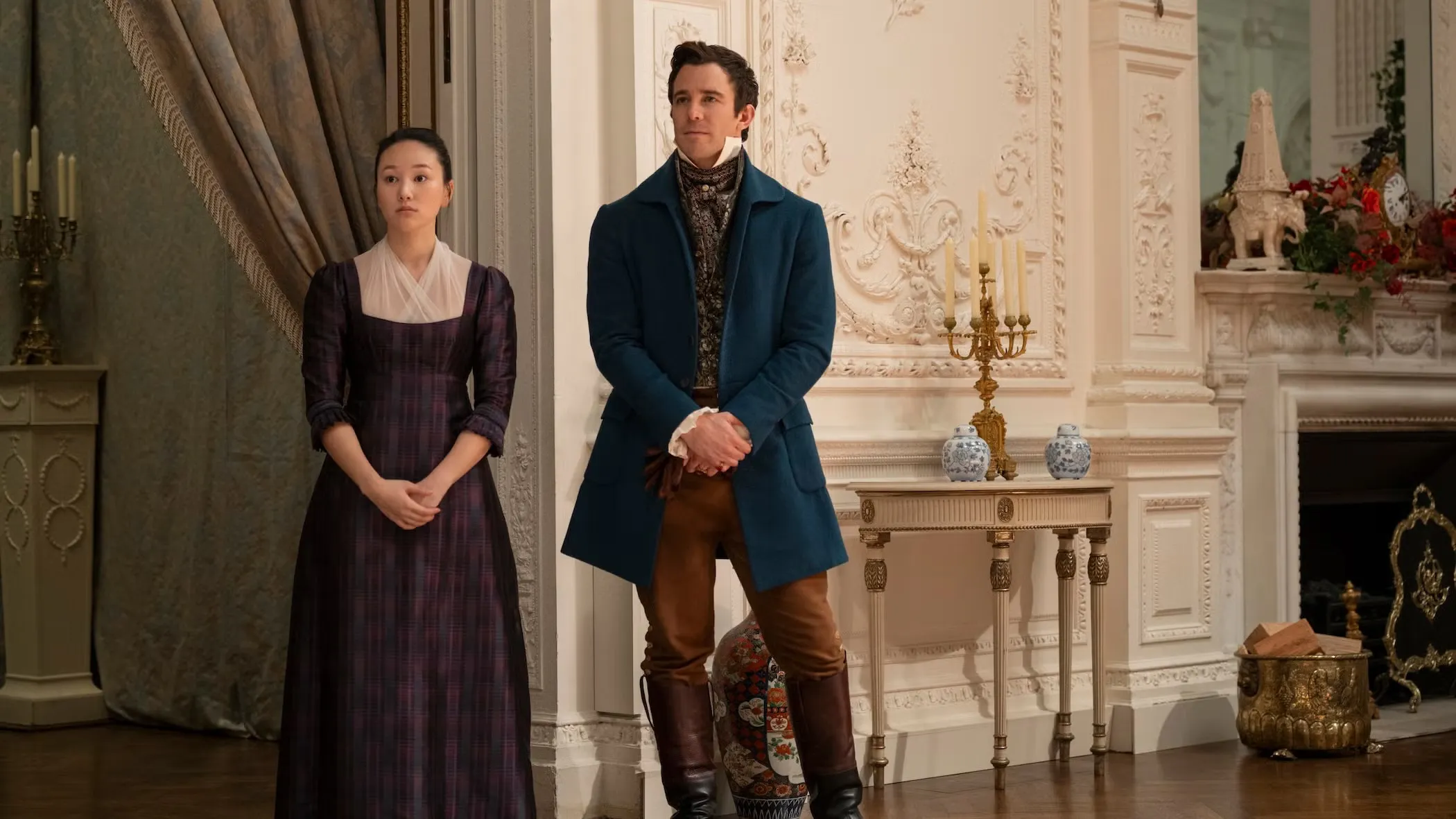
Bridgerton is known for its frank portrayal of desire, but Season 4 employs intimacy with greater restraint and intention. These scenes are not merely for sensation, but to highlight the power dynamics within the relationship: who has the right to propose, who must weigh the consequences, and who can walk away with minimal loss.
In this respect, Season 4 carries a more somber tone than previous installments. Love is no longer an absolute refuge, but a space where social conflicts become most visible. This fragility makes the story more thought-provoking, rather than simply captivating through sweet romantic exchanges.
The Glittering High Society Remains a Pillar of Season 4
Alongside the central romance, Season 4 sustains the vitality of the Bridgerton world through its subplots. The Bridgerton family, marriage negotiations, and power relations within high society continue to operate like a constantly moving machine. Familiar characters provide narrative stability while reflecting different ways of adapting to the same system. Some choose compromise. Some seek control. Others grow weary. The social portrait thus expands beyond a single romance into a broader question: should one conform to or resist predetermined structures?
Visually, Season 4 remains a feast for the eyes. Costumes, lighting, and settings are meticulously crafted. Yet this beauty now carries deeper layers of meaning, reflecting disparities in power and status. The masquerade ball is staged as a realm of fantasy, where identity can momentarily dissolve. Once the story leaves that space, the palette and lighting shift toward realism and gravity.
Benedict’s styling is more restrained, less ostentatious, aligning with his internal journey. The private spaces where he and Sophie meet feel warm, but never entirely safe — subtly suggesting that their intimacy is always at risk of intrusion from the outside world. Beauty thus becomes an emotional guide, not merely decorative spectacle.
A More Realistic and Reflective Season

At first glance, Bridgerton Season 4 may feel slow or understated to some viewers. It does not rush from climax to climax, nor does it constantly push emotions to their peak. Instead, it takes time to lay the groundwork for conflicts that resist easy resolution. This approach reflects the season’s ambition: to tell a story in which love does not magically resolve all injustice. The series poses questions, exposes contradictions, and places characters before uncomfortable choices. The remainder of the story will determine whether Bridgerton dares to follow through on the path it has opened.
Season 4 marks a subtle turning point for the series. Still romantic, still seductive, but more thoughtful and restrained. Benedict and Sophie’s love story is not crafted to fulfill a fairy-tale fantasy, but to challenge it. In a world of glitter and excess, this season leads viewers toward more human questions — about dignity, choice, and the responsibility that accompanies love.
If earlier seasons captivated audiences through opulence and escapism, Season 4 invites them to linger with thoughts that are not entirely comfortable. It is precisely this direction that shows Bridgerton knows how to renew itself — not by dismantling its lavish world, but by quietly illuminating the cracks that have always existed beneath its polished surface.