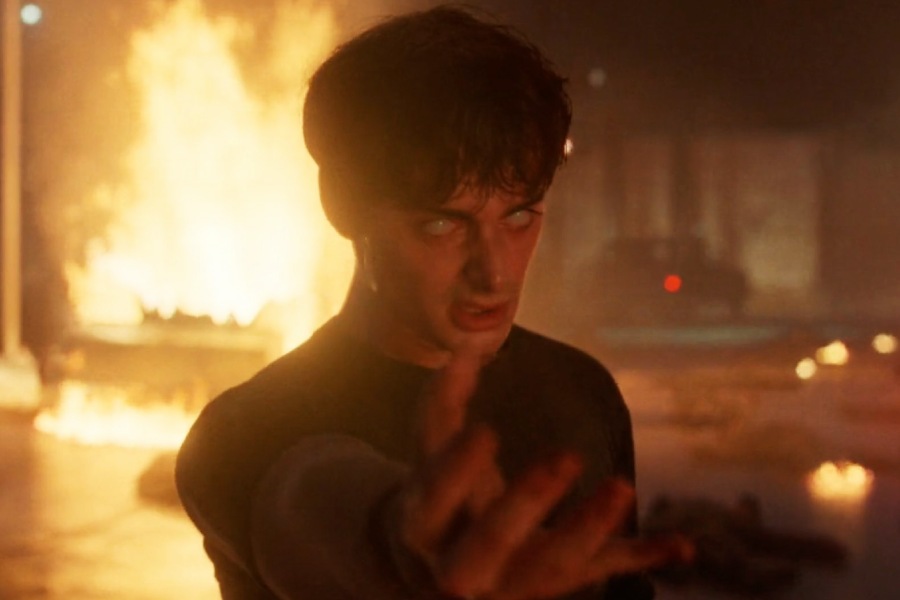
For years, Stranger Things fans assumed Will Byers was simply the show’s emotional core — the boy taken, the boy haunted, the boy connected to the Upside Down. But as Season 5, Volume 1 lands, it’s now clear the Duffers had a far more ambitious endgame in mind.
“Will the Wise,” a nickname first dropped in Season 1 as a child’s Dungeons & Dragons avatar, was never just a cute Easter egg. According to the showrunners, it was the earliest clue to Will’s true narrative function — and to a power set fundamentally unlike Eleven’s or Vecna’s.
And, if the Duffers’ newest revelations are any indicator, Will may very well be the decisive force in the series’ final battle.
The Wizard Identity Was Never Accidental

Long before Season 5 revealed the full extent of Will’s powers, Stranger Things had been quietly laying the groundwork:
-
Will’s drawings of Will the Wise wielding fireballs and protective spells
-
Will’s wizard costume in Season 2
-
Mike’s recurring questions about whether Will possesses “True Sight”
-
Will’s uncanny sensitivity to shifts in the Upside Down
Revisited now, these details form a unified narrative: Will was always meant to be a Wizard, in the strictest D&D sense — a magic user defined not by innate power, but by learned mastery.
The Duffers Explain: Eleven and Vecna Are Born With Power — Will Is Not

In a recent interview with Variety, Matt and Ross Duffer offered the clearest explanation yet of Will’s supernatural role:
Ross Duffer: “Will’s powers don’t originate inside him the way they do for Eleven or Henry.”
Matt Duffer: “He accesses Vecna’s abilities through the hive mind. It’s like puppet strings. He can control anything connected to the hive — but only when he’s close enough to it.”
The implications are enormous:
-
Eleven and Henry/Vecna are innate magic users — comparable to Sorcerers (or, in Eleven’s case, a Mage, an umbrella term for natural power).
-
Vecna, as a transformed undead magic user, aligns with D&D’s Lich class.
-
Will, meanwhile, is a Wizard — a character who acquires magic through study, discipline, and external sources.
This also explains why:
-
Will can sense Vecna anywhere
-
Can synchronize with the hive mind
-
Can control Demogorgons in Season 5
-
But cannot open portals or manipulate matter like Eleven
His abilities are borrowed, not innate.
Why Vecna Didn’t Kill Will in Season 1

One of the longest-running fan questions finally has an answer.
Why did Vecna — who has no hesitation annihilating children — let Will live?
Matt Duffer addressed the question directly:
“Vecna completely underestimated Will. He saw him the same way many people in Will’s life did: weak, insignificant, incapable of anything great.”
This miscalculation now forms the backbone of Will’s Season 5 arc.
Vecna not only spared Will — he inadvertently gave Will access to the hive mind, the very source of his own power. And in Volume 1, when Will dispatches a Demogorgon using the exact same psychic technique Vecna uses on his victims, the narrative irony becomes unmistakable:
Vecna created his own worst enemy.
Why Will Is a Wizard — Not a Sorcerer, Despite Mike’s Theory
In Season 2, Mike famously muses:
“Maybe in real life, Will’s a Sorcerer. He doesn’t even need a spellbook.”
But as Matt and Ross Duffer confirm — Mike simply didn’t have the full picture.
In D&D lore:
| Class | Source of Power |
|---|---|
| Wizard | Learned magic, external study, disciplined training |
| Sorcerer | Innate magic, bloodline gifts, inherited ability |
| Mage | Broad term; usually indicates inherent power |
| Lich | A powerful spellcaster reborn as an undead entity |
Will matches the Wizard archetype perfectly:
-
He was once powerless.
-
He gained access to magic only after being absorbed into Vecna’s hive mind.
-
His strength grows as he learns to control it.
And unlike Sorcerers, who often wield power impulsively, Wizards rely on intellect, discipline, and — crucially — willpower.
Will’s True Power Isn’t Magic — It’s His Will

In one of the most symbolic pieces of narrative design, Will’s name itself contains the show’s thesis.
-
Will = “willpower,” “determination”
-
William/Wilhelm = “resolute protector”
The Duffers are famously meticulous with names, and here the symbolism is overt:
Will’s magic activates only when he draws upon his deepest emotional strength — the desire to protect his friends.
Volume 1’s most chilling moment — Will killing Demogorgons with Vecna’s own psychic technique — isn’t just spectacle. It’s the narrative payoff for five seasons of character-building.
Vecna underestimated Will.
The audience underestimated Will.
Even Will underestimated Will.
But the hive mind didn’t erase him — it amplified the part of him that Vecna cannot control:
his resolve.
The Endgame: Why Will the Wise May Be the Key to Ending the Upside Down
Taken together, one conclusion becomes clear:
Will is neither villain nor chosen one — he is the bridge between the human world and the hive mind.
-
Eleven is pure power.
-
Vecna is pure corruption.
-
Will is the one character who understands both worlds.
He is:
-
the only person who has lived in the hive mind and survived
-
the only character who can channel Vecna’s abilities
-
the only one driven entirely by selfless protection
If Stranger Things ends with a collapse of the hive mind, the reset of the Upside Down, or a final psychic confrontation, Will the Wise is positioned to be the decisive force — the Wizard who defeats the Lich not by power, but by will.