The stage was set for history. After 31 consecutive victories, New Jersey contestant Jamie Ding returned to Jeopardy! for what many believed would be a coronation—his 32nd game, the one that could tie him with legendary high-stakes player James Holzhauer and cement his name among the show’s most dominant forces.
Instead, it became something else entirely: a collapse no one saw coming.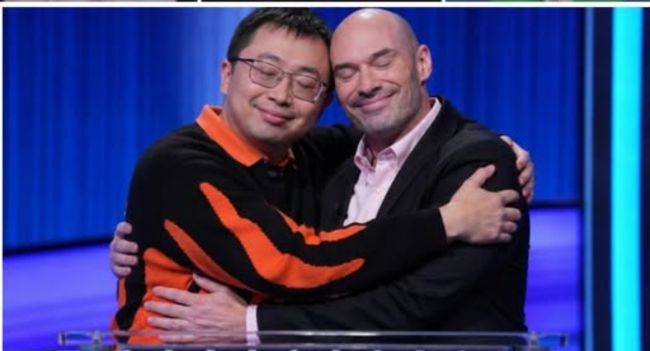
A STREAK THAT DEFIED EXPECTATIONS—AND PUSHED THE LIMITS OF ENDURANCE
Ding’s run had already rewritten the narrative of modern Jeopardy!. Over the course of 31 straight wins, he amassed $882,605 and climbed into the top five for both earnings and consecutive victories—an elite tier occupied by names like Ken Jennings and Amy Schneider.
Calm, methodical, and quietly charismatic, Ding wasn’t the flashy gambler archetype. He was precise—clinical even—racking up correct responses at a pace that stunned audiences and analysts alike.
But beneath the surface, the pressure was mounting.
Even Ding himself later admitted the experience felt relentless, describing the streak as something that could “go on forever” while quietly draining him.
And as Game 32 approached, the stakes shifted from impressive to historic.
GAME 32: WHEN CONTROL SLIPPED—AND MOMENTUM CHANGED HANDS
Facing him was an unexpected challenger: Greg Shahade, an international chess master known more for strategic calculation than television drama.
From the outset, something felt different.
Shahade didn’t just compete—he dictated. By correctly hitting all three Daily Doubles, he seized control of the board early and built a lead that Ding, for the first time in over a month, couldn’t dismantle.
Then came the moment that would echo across headlines.
A seemingly minor clue about Dubai’s iconic palm-shaped islands—one that Ding answered incorrectly—cost him valuable ground at precisely the wrong time.
It wasn’t catastrophic on its own. But in a game defined by margins, it was enough.
THE FINAL ROUND THAT CHANGED NOTHING—AND EVERYTHING
By the time Final Jeopardy arrived, the outcome was already slipping beyond reach.
All three contestants answered correctly. Ding knew the answer. The knowledge was still there. The precision hadn’t vanished.
But the numbers told a different story.
Shahade’s earlier dominance meant the final reveal was a formality. Ding, once untouchable, finished with $19,010—well behind Shahade’s $33,000.
In a quiet, almost symbolic gesture, Ding reportedly wrote “TTFN”—ta-ta for now—on his response screen, acknowledging the inevitable.
Just like that, the streak was over.
ONE GAME SHORT OF IMMORTALITY
The loss froze Ding at 31 wins—one shy of Holzhauer’s 32-game benchmark, and far from Jennings’ towering 74-game record.
In Jeopardy! history, that single game is everything.
It is the difference between “one of the greats” and “the one who tied the record.”
And yet, Ding’s legacy remains undeniable. His run is the longest in years, his earnings place him among the elite, and his style—disciplined, unflashy, relentless—offered a stark contrast to the high-risk strategies that defined predecessors like Holzhauer.
A DEFEAT THAT FEELS STRANGELY… COMPLETE
In the aftermath, there was no visible frustration. No dramatic collapse. No bitterness.
Only perspective.
Ding described the ending as “bittersweet,” even expressing relief that the streak had concluded before exhaustion overtook him completely.
It’s a rare sentiment in a moment that, for many, would feel like failure.
But perhaps that’s the final twist in this story.
Because in a game built on knowledge, timing, and precision, Jamie Ding didn’t lose because he didn’t know enough.
He lost because, for the first time in 32 days… someone else played the game just a little better.