Investigators are racing to understand what caused five experienced Italian tourists to die during a catastrophic deep-water scuba expedition in the Maldives — and now diving experts believe the tragedy may have unfolded through one of the most terrifying underwater scenarios imaginable.
A silent physiological breakdown.
 Followed by panic.
Then complete disorientation hundreds of feet below the surface.
According to new expert analysis emerging after the deadly incident near Vaavu Atoll, oxygen toxicity — also known as hyperoxia — may have played a critical role in the deaths of the five divers who vanished during a 160-foot cave exploration dive earlier this week.
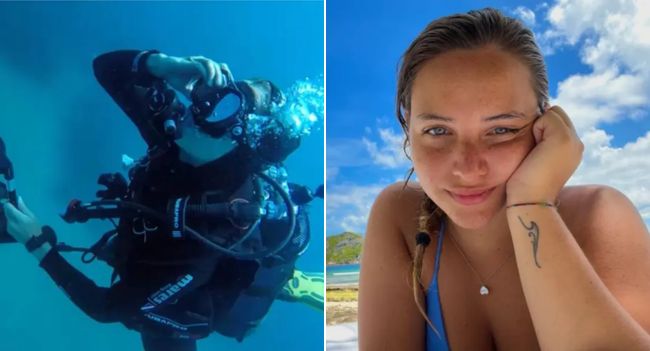
The victims included respected marine ecology professor Monica Montefalcone, her daughter Giorgia Sommacal, research fellow Muriel Oddenino, marine biology graduate Federico Gualtieri, and diving instructor Gianluca Benedetti. Authorities say the group descended into underwater cave systems near Alimatha Island after departing aboard the dive yacht Duke of York — but never resurfaced.
Now experts fear something may have gone catastrophically wrong with the divers’ breathing gas mixture.
Pulmonologist Claudio Micheletto told Italian media that because all five divers died during the same descent, investigators cannot rule out the possibility of oxygen toxicity linked to the tanks being used during the expedition. Recreational divers normally breathe compressed air containing roughly 21% oxygen, but some advanced dives use enriched mixtures such as nitrox, which contains higher oxygen concentrations. At extreme depths, those mixtures can become dangerous — even deadly.
And at nearly 160 feet underwater, experts warn the risk intensifies dramatically.
According to Micheletto, oxygen toxicity underwater can trigger dizziness, altered consciousness, tunnel vision, muscle spasms, confusion, seizures, and sudden unconsciousness — conditions that become almost impossible to survive in deep cave environments. “Death from oxygen toxicity is one of the most dramatic deaths that can occur during a dive,” the specialist reportedly warned.
But oxygen toxicity alone may not explain the entire nightmare.
Hyperbaric medicine experts now believe panic may have rapidly escalated the disaster once one or more divers became distressed underwater. In deep cave systems, visibility can vanish instantly if sediment is disturbed. Divers can lose orientation within seconds, especially in confined spaces where escape routes become difficult to locate.
That combination — physiological distress mixed with underwater panic — is exactly what many divers fear most.
Studies on scuba fatalities consistently show panic and emergency ascents are among the leading causes of deadly diving accidents, especially during deep or technically demanding dives. Human error, disorientation, insufficient gas, entrapment, and rapid ascents can quickly create fatal chain reactions underwater.
The environmental conditions may have made the situation even worse.
Reports indicate weather warnings had already been issued in the Maldives due to rough seas and strong currents before the dive began. Several sources claim visibility conditions around the cave systems may also have been unstable due to ocean movement and sediment disturbance.
Recovery operations themselves became dangerously difficult.
The Maldives National Defence Force reportedly recovered one victim from inside a cave nearly 200 feet deep, while authorities believe the remaining bodies were located within the same underwater cave system. Rescue crews faced serious risks navigating the confined underwater environment during search efforts.
The tragedy is now being described as one of the deadliest diving disasters in Maldivian history.
And as investigators continue analyzing tank data, dive plans, gas mixtures, weather conditions, and underwater routes, one disturbing possibility is beginning to dominate discussions inside the global diving community:
That the divers may not have died from a single mistake at all — but from a terrifying sequence where one moment of confusion underwater triggered a panic cascade from which nobody inside the cave could escape.