The Age Anomaly: Reconciling the Conflicting Ages of Henry Creel in Stranger Things 4 and The First Shadow
This article aims to clarify some pressing questions surrounding the inconsistency—the noticeable stepping on toes—between the Stranger Things TV series and the stage play, The First Shadow, regarding the age of Henry Creel. This discussion arises because I previously used The First Shadow as a source to explain certain unanswered questions in Season 5, Volume 1, which prompted queries about this very inconsistency. Since some plot points lack concrete proof, I will proceed with theory-based reasoning derived from available evidence.

Firstly, the Duffer Brothers and playwright Kate Trefry have confirmed the play as Canon. This means everything that occurs in the play has, functionally, occurred within the timeline of the show, and they are mutually supportive narratives. Therefore, the argument that the events in the play should be disregarded due to contradictions is invalid.
Given the play’s canonical status, we immediately encounter a contradiction regarding Henry’s age in the 1959 timeline. In the show, Henry is implied to be 12 years old, but in the play, he is approximately 17, placing him in the same age bracket as the core group (Jim, Joyce, Bob, and the parents of Dustin and Mike). The reasons for this adjustment are theorized as follows:

The writers deliberately aged Henry up, changing him from a middle-schooler to a new transfer student at Hawkins High School. Had Henry remained a 12-year-old child, he would never have met or interacted with the 18-year-old Joyce and her peers. This age change avoids a narrative domino effect: scenes where Henry acts alongside Patty, or is interrogated by Hopper, would be impossible if he were just a 12-year-old boy. By making them all high school classmates, the play amplifies the tragedy and escalates the tension: Vecna is not a stranger; he is the murderous friend they once faced.
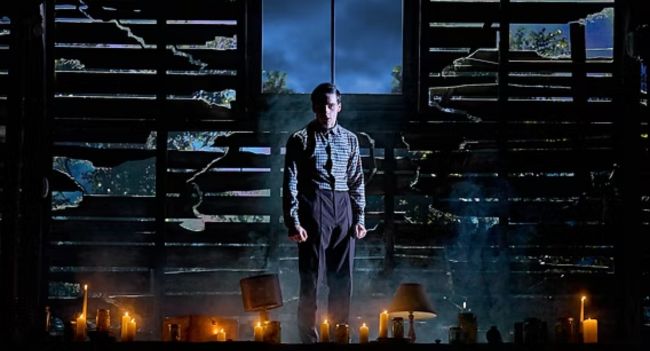
None of this has been directly or explicitly explained by the showrunners or writers. They have only mentioned in interviews that they wanted to establish a deep, personal narrative connection between the villain (Vecna) and the heroes (Jim, Joyce, Bob) from the very beginning of their past. The Duffer Brothers even view the play as an absolutely essential and indispensable part of the Stranger Things lore, containing crucial clues for Season 5.
Therefore, accepting the play as Canon implies we must accept a “soft retcon”—a slight narrative revision—that Henry Creel was, in fact, older than the newspaper clipping in Season 4 suggested. Alternatively, we can explore three plausible theories to rationalize this discrepancy:
Theory 1: The Press Got It Wrong (In-Universe Error)
The Weekly Watcher newspaper in Season 4 may have reported Henry’s age incorrectly. Media error was common at the time, or perhaps the Creel family intentionally misreported his age to cover up his past behavior and minimize the severity of his actions.
Theory 2: The Unreliable Narrator (Vecna’s Manipulation)
What we witnessed in Season 4 may actually be memories that Vecna intentionally projected into Nancy’s mind. He may have distorted his self-image (appearing smaller, more innocent) to manipulate her. He wanted Nancy to see a child alienated by his family, not a dangerous teenager who had fallen in love and committed murder. Thus, the 12-year-old Henry seen in the show might be a false veneer created by Vecna.
Or, he may have a greater, more sinister motive: Henry wanted to conceal the fact that he once had connections with the adult generation of Hawkins (like Nancy’s parents or Joyce). Realizing that the original adult group was no longer in Hawkins, he pushed forward with his plan, injecting Nancy with a fabricated memory to prevent her from finding his critical, bygone weakness.
Theory 3: The Academic Delay (The Traumatic Gap)
The play reveals that prior to moving to Hawkins, Henry caused a severe accident in Nevada (blinding/breaking a classmate’s arm). This event may have led to psychological issues, legal complications, or treatment following his 12-hour disappearance into Dimension X. This could have disrupted his schooling, causing Henry to enroll later than his actual age. Therefore, while Henry might physically appear younger than his real age (or perhaps was physically affected by becoming the Mind Flayer’s host), legally and chronologically, he was old enough to be a student at Hawkins High.
In conclusion, those who are easygoing may overlook this puzzling age difference, while critics might view it as an unnecessary plot hole and a clear inconsistency. The issue isn’t just baffling to the local fanbase; Reddit and international fandoms are furiously debating this very conflict. Since the showrunners have confirmed the play’s Canon status to the main series, viewers must ultimately accept this plot hole as an essential part of the larger narrative.