For more than a month, Jamie Ding existed in a rare space few contestants ever reach—somewhere between dominance and inevitability. Night after night on Jeopardy!, he didn’t just win; he controlled the game with a level of precision that made even strong challengers feel secondary. By the time he crossed into his 30th consecutive victory, the narrative had already shifted from “Can he lose?” to “How far can this go?”
Then came the episode that changed everything.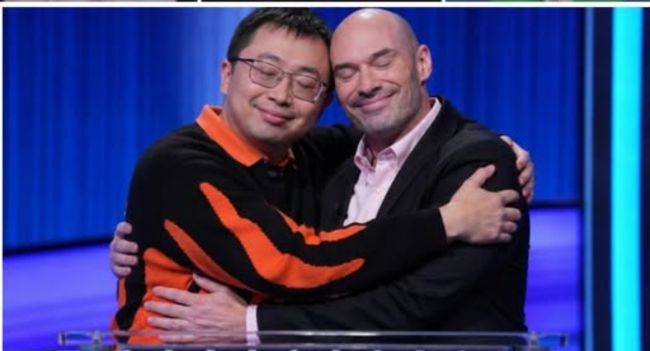
A STREAK BUILT ON CONTROL—AND THE PRESSURE NO ONE COULD SEE
Ding’s 31-game run placed him firmly among the greatest in Jeopardy! history, earning $882,605 and climbing into the top tier of all-time champions.
But streaks like this don’t just build momentum—they build pressure.
Behind the calm delivery and measured responses was a routine that demanded near-perfect recall, timing, and endurance. Even Ding later admitted the experience felt relentless, describing it as something that could “go on forever” while quietly wearing him down.
To viewers, he looked composed. Inside the game, the margins were tightening.
THE GAME WHERE EVERYTHING FELT… DIFFERENT
From the opening clues of his 32nd appearance, something subtle had shifted.
His opponent, chess master Greg Shahade, didn’t just keep pace—he disrupted it. Aggressive play, strategic wagering, and precise buzzer timing began to chip away at Ding’s control of the board.
For the first time in weeks, Ding wasn’t dictating the rhythm.
He was chasing it.
And in a game defined by fractions of seconds and incremental swings, that difference was enough to tilt everything.
A LOSS THAT WAS DECIDED BEFORE THE FINAL MOMENT
By the time Final Jeopardy arrived, the outcome was already clear.
Despite answering correctly, Ding couldn’t recover. Shahade’s earlier lead had grown too large, turning the final round into a formality rather than a comeback opportunity.
Statistically, it was a clean defeat—a “runaway” loss, one that left no single mistake to blame.
But emotionally, it didn’t land like one.
THE REACTION THAT DIDN’T MATCH THE MOMENT
What lingered wasn’t the scoreboard—it was Ding himself.
In a moment where most champions show visible frustration, there was none. No collapse, no outward disappointment. Just a composed, almost detached presence that felt out of sync with what had just happened.
He signed off with a simple message—“Ta ta for now”—a brief farewell that, on paper, suggested optimism.
But to many watching, it felt like something else entirely.
Not an ending forced upon him.
An ending he had already accepted.
A LEGACY SECURED—AND A QUESTION LEFT OPEN
With 31 consecutive wins, Ding finishes as one of the most successful contestants in the show’s history—just one game short of tying James Holzhauer’s 32-win benchmark, and still far behind Ken Jennings’ legendary 74.
His place in the record books is unquestionable.
And yet, the way it ended continues to invite speculation.
Because if this was simply a loss, it should have looked like one.
Instead, it felt quieter. Cleaner. Almost… resolved.
And according to one account circulating from someone present during filming, what happened after the applause faded—and what Ding reportedly said when the cameras were no longer rolling—may explain why that final moment didn’t feel like defeat at all… but something far more deliberate.