US Airman Rescued From Iran Used Boeing Device To Signal Rescuers
A massive rescue effort got underway “following confirmation of active rescue beacons,” General Dan Caine, the chairman of the Joint Chiefs of Staff, said Monday. The plane’s pilot – call sign Dude 44 Alpha- was rescued Friday
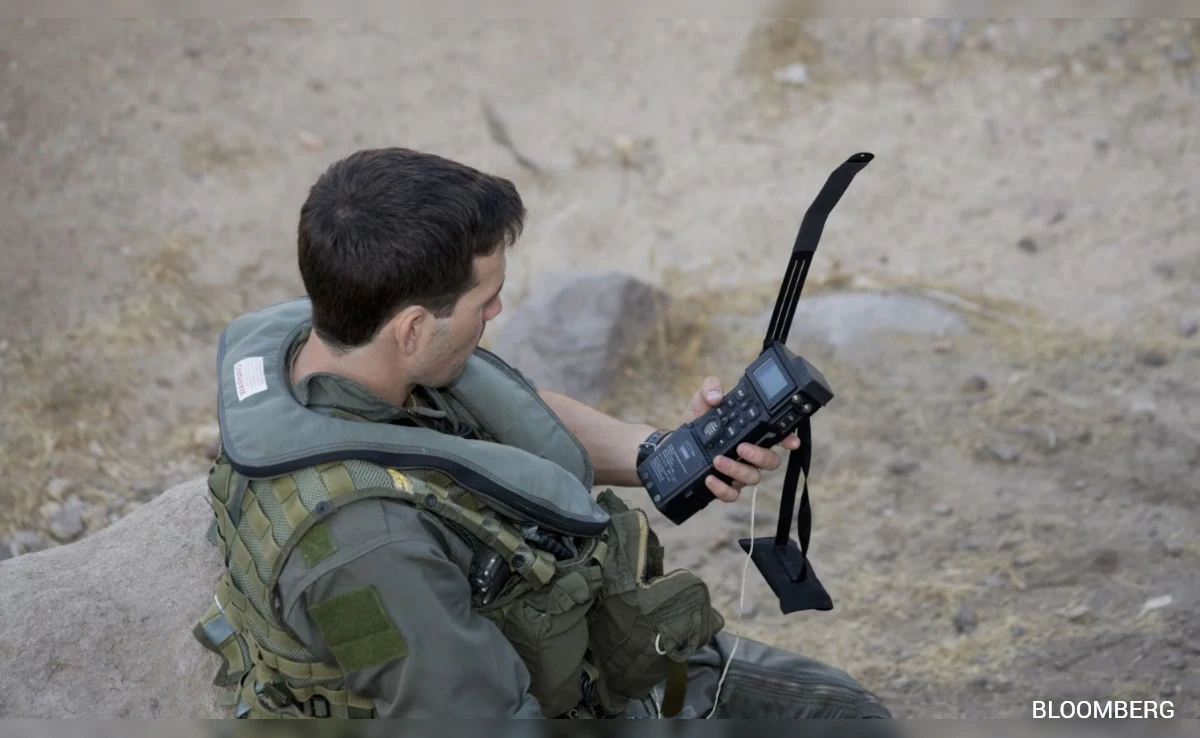
The Air Force airmen rescued from Iran by an armada of helicopters, other aircraft and commandos used a standard issue Boeing Co. communications device to alert their comrades and signal their locations, according to a service official.
“They have a very sophisticated beeper-type apparatus that is on them at all time,” President Donald Trump said Monday at a wide-ranging White House news conference about the complex weekend operation.
“When they go out on these missions, they make sure they have lots of battery space and they’re in good shape, and this one worked really well – amazingly, saved his life,” Trump said of the communications device and the missing airman who the president said had taken refuge “in the treacherous mountains of Iran.”
That device is the Boeing Combat Survivor Evader Locator, or CSEL, said the Air Force official. The Air Force and Navy have bought thousands of the hand-held unit since it became fully operational in 2009. The evader locator “provides secure two-way over-the-horizon, near real time data communications, precise military Global Positioning System, and increased radio frequencies and modes of communications over existing radios,” according to a Navy fact sheet.
Stranded personnel can send a data message via satellite to a central rescue center. The center forwards that message to rescue forces, who then communicate with the survivor via voice communications to help with recovery, according a Pentagon test report. In this case, the Pentagon’s Joint Personnel Recovery Center coordinated the effort.
More than 50,000 of the devices had been delivered, as of 2011, the latest public Air Force accounting.
The multi-function handset was crucial to locating the two-man crew after their F-15E warplane was hit by what Trump called a “lucky shot” from a shoulder-fired missile.
A massive rescue effort got underway “following confirmation of active rescue beacons,” General Dan Caine, the chairman of the Joint Chiefs of Staff, said Monday. The plane’s pilot – call sign Dude 44 Alpha- was rescued Friday in a daylight operation.
The F-15E’s weapons system operator, call sign Dude 44 Bravo, although badly injured “continued to work and survive” to evade capture as the US used “every means available,” with the assistance of the Central Intelligence Agency, to locate his precise location, Caine said.
“Thanks to our interagency partners, we were able to get eyes on his location and positively ID him,” Caine added. He was rescued Saturday night so that “at midnight 12 local Eastern time, Easter Sunday, more than 50 hours after the start of this operation,” both airmen were back in friendly territory, the general said.
In the hunt for Dude 44 Bravo, the CIA “deployed both human assets and exquisite technologies that no intelligence service in the world possesses to a daunting challenge comparable to hunting for a single grain of sand in the middle of a desert,” the agency’s director, John Ratcliffe told reporters.
“On Saturday morning, we achieved our primary objective by finding and providing confirmation that one of America’s best and bravest was alive and concealed in a mountain crevice, still invisible to the enemy but not to the CIA,” Ratcliffe said.