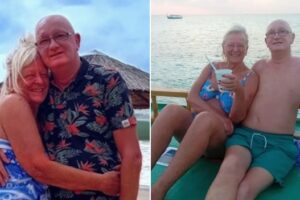
Vacationing doctor who stepped in to treat hantavirus patients on MV Hondius tests positive for virus
A vacationing doctor who stepped in to treat hantavirus patients on the MV Hondius after the ship’s chief medic fell ill is isolating inside a biocontainment unit after also contracting the virus.
Retired oncologist Stephen Kornfeld was put in isolation after landing in Omaha, Nebraska – but told CNN Tuesday he’s feeling wonderful and currently showing no symptoms.
Kornfeld, one of 16 passengers who arrived in Omaha Monday, said he experienced flu-like symptoms while at sea — unaware that it could be hantavirus.

“I had three days of night sweats, a lot of chills, some mild respiratory problems, and a lot of fatigue,” he said.
“While the night sweats and the respiratory symptoms cleared up pretty quickly, fatigue lingered for about two-and-a-half weeks.”
Kornfeld, from Oregon, treated hantavirus patients when the ship’s chief medic fell ill – and was tested for the virus. Two of his samples were sent to the Netherlands, and one returned a “faintly positive” result.
He is being quarantined in the unit out of an abundance of caution after his test result was forwarded onto the authorities.
“I feel great, I feel wonderful, 100%,” he said. “It’s still possible that the test represents an evolving disease, and I will get symptoms down the road. This is why I’m in the biocontainment unit.”
Kornfeld is expected to receive more test results by Friday. If negative, he will be reunited with the other 15 passengers at the University of Nebraska Medical Center.
Two others, including one who tested positive and another showing mild symptoms, were taken to Emory University’s Serious Communicable Diseases Unit for further evaluation, officials said.
Passengers are being monitored for 42 days – the virus’s incubation period — but authorities have always maintained the risk to Americans is low, something which has been echoed by Kornfeld.
“This is a very secure facility. So if I am to get sick, there’s no way that virus is getting out of this building,” he said.
Kornfeld previously told CNN how he “fell into the role of becoming the ship’s doctor” and he treated patients without fully realizing it was hantavirus.
He said how he didn’t really feel “super vulnerable” – despite the limited protective equipment on board the ship.

“You’re just trying to do the best you can in the circumstances with somewhat limited resources on a cruise,” he said.
The ship was stocked with anti-inflammatory meds and oxygen tanks – but wasn’t kitted out with scanners that could detect hantavirus, Kornfeld told the Atlantic.
A total of 94 passengers were evacuated from the ship on Sunday after it docked in Tenerife, Spain. The ship’s docking location sparked fury among politicians and some locals amid fears of the COVID pandemic.

Health officials have since revealed 11 people on board the ship contracted the Andes strain of the virus, which carries a 40% mortality rate.
But, possible hantavirus cases have been reported among some who were not on board the ship.
A resident living in Winnebago County, Illinois, may have caught the virus when cleaning a home where rodent droppings were present, the Illinois Department of Public Health said Tuesday. Their symptoms were mild and they didn’t require hospitalization.
Five other Americans are also being monitored for hantavirus despite not stepping foot on the ship.
Two New Jersey residents, two Marylanders, and one Californian are in isolation under the strict supervision of health department officials after they all took international flights that included passengers from the cruise.