Artemis II live updates: Weather for splashdown looks mild, monitoring for rain
The Artemis II crew lifted off at 6:35 p.m. ET on Wednesday, April 1.
NASA’s Artemis II mission lifted off on April 1 at 6:35 p.m. ET from the Kennedy Space Center in Florida.
The four-person crew is on a 685,000-mile, 10-day journey around the moon, also known as a lunar fly-by.
What to know about NASA’s Artemis II moon mission
Artemis II will make history, taking astronauts around the moon for the first time in more than 50 years. The four-person crew will launch from NASA’s Kennedy Space Center on Merritt Island, Florida, for a 10-day journey.
The trip will pave the way for future Artemis missions intended to eventually see astronauts set foot on the moon, and the building of a permanent lunar base.
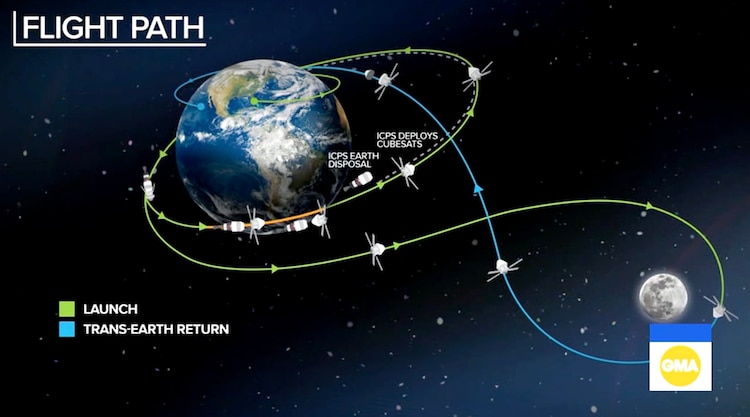
Read more here about what you need to know regarding the Artemis II mission, including how long it will take, who the astronauts are and how to watch.
NASA shares 1st images of Artemis II lunar flyby, including Earthset
NASA has shared the first photos from the Artemis II crew’s historic lunar flyby, including a stunning image of Earth.
The photo shows the crew’s view of an Earthset as the planet disappears beyond the lunar horizon and the astronauts make their way to the far side of the moon.

The photo bears a striking resemblance to “Earthrise,” a photo taken in 1968 from lunar orbit by astronaut William Anders during the Apollo 8 mission, which was the first crewed mission to reach the moon.

Artemis II crew recreates ‘Full House’ opening
The Artemis II crew put its own spin on the “Full House” opening credits, recreating the intro and calling it “Full Capsule.”
The video features the opening theme to the TV show, “Everywhere You Look,” introducing the crew along with clips of life inside the Orion spacecraft.
Also featured in the clip is “Rise,” the plush toy designed by a second grader, who won a contest for his toy to go to space with the crew.
NASA shares more photos of far side of the moon
NASA has shared additional photos of the far side of the moon taken during the Artemis II crew’s historic lunar flyby on Monday.
One image shows a close-up view of Vavilov Crater, an impact crater on the rim of the older and larger Hertzsprung impact basin, none of which can be seen from Earth.

Another image shows the Orientale basin in the center with a black patch of ancient lava that punched through the moon’s crust in an eruption billions of years ago. It is located on the western border between the near and far side of the moon and is hard to see from Earth.

A third image captures the lunar surface in sharp detail while a distant Earth hovers in the background.

Also captured by the Artemis II crew is the heavily cratered terrain of the eastern edge of the South Pole-Aitken basin, an impact crater on the far side of the moon.
The basin is seen with the shadowed terminator — the boundary between lunar day and night — at the top of the image.