“It: Welcome to Derry” is not only the first Stephen King adaptation where nobody is safe, it’s the first to provide a fully realized backstory for Pennywise the clown, and it seems the original creator of this legendary horror villain had pretty much nothing to do with it. Why? Well, because Stephen King never wrote a backstory for the character into his original novel, which as Andy Muschietti, co-creator and director of “Welcome to Derry,” explained during a recent interview, was a work of suspense that intentionally kept audiences in the dark about certain things.
Like all good horror stories, “It” works so well because so much of the story remains a mystery. Who is It? What does It want? And how did It come to Derry? None of these questions are fully explained in King’s original 1986 novel, which only serves to make the titular entity that much more unknowable and therefore imposing. This is a creature that feeds on fear, and horror itself thrives on fear of the unknown.

So, when Muschietti, director of the 2017 “It” adaptation and its 2019 sequel, “It: Chapter Two,” decided to make a show explaining everything mysterious about the evil force and its most infamous corporeal form, Pennywise, King must have hesitated for at least a second. At least, you’d think he would, but it seems the author was mostly hands-off when it came to crafting the newly-created backstory told in “It: Welcome to Derry,” allowing Muschietti and co. to create pretty much unimpeded.
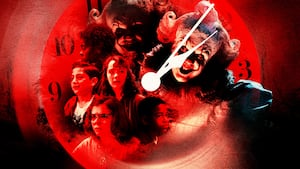
“It: Welcome to Derry” acts as a prequel story to Andy Muschietti’s two aforementioned films. Show creators Jason Fuchs, Andy, and Barbara Muschietti are planning a trilogy of “Welcome to Derry” seasons that will collectively turn the modern on-screen “It”-verse into a far more rich and realized thing. Those seasons will chart three of the most significant times It has emerged from its slumber beneath Derry to terrorize the townspeople. By the end, there should be very little left to explain — especially considering the first season has already revealed Pennywise’s origin story.
In Stephen King’s “It” novel, the titular entity tells Georgie Denbrough that its name was Bob Gray, a human who went by the moniker Pennywise the Dancing Clown. However, there’s no explanation or elaboration on that point, which left Muschietti and his “Welcome to Derry” co-creators with a lot of creative freedom when it came time to write their prequel series.
Much of that manifested in episode 7 (which beat the movies with a major character death), where we finally see how It came to take on its nightmarish harlequin form. As it turns out, in the Muschietti-verse, Pennywise (Bill Skarsgård) was a real clown portrayed by a man named Bob Gray (also played by Skarsgård). The episode shows how, after a performance, Gray was led into the forest by It in the form of a young boy, where the entity devoured the circus performer and took on his appearance. It’s not the most elaborate tale but it’s hugely significant for providing fans with an actual backstory to the Pennywise persona. And according to Andy Muschietti, Stephen King had pretty much nothing to do with that origin tale.

Andy Muschietti spoke to Deadline’s Crew Call where he was asked about creating a backstory for Pennywise based on scarce details from the original novel. “One of the great things about the book is that there’s a lot of crumbs and pieces of information,” he said, “which are pieces of a puzzle. We took those pieces as the big pillars to create a new story.”
The director went on to explain how there was a lot of invention involved in “Welcome to Derry” simply due to the fact that King hadn’t provided many concrete details about It or Derry’s past in his book. According to Muschietti, the author was fine with that. He explained that King “was game” for the project and essentially told the co-creators “‘Okay, let’s see what you guys got.'”
Asked if King had any notes on the Pennywise origin story that the co-creators eventually crafted, Muschietti said, “He didn’t have much notes because his work, on ‘It,’ is a work of suspense, of creation.” The co-creator went on to explain how Bob Gray is “a very cryptic figure” in the books, though now that “Welcome to Derry” has explained all, he’s far less so.
This fleshing out of King’s original tale is both the show’s strength and the biggest problem in “Welcome to Derry,” and could be catastrophic for Pennywise by making him far less mysterious and therefore robbing him of much of his cosmic horror appeal. Still, there’s no doubt the show remains compelling even after having answered one of the biggest questions fans had about one of the most legendary scary clowns in horror history.
Read More: https://www.slashfilm.com/1946277/plot-holes-ruined-movies/