LOUISVILLE, KENTUCKY — The 152nd Kentucky Derby did not end the way history books, bookmakers, or even seasoned racing insiders expected. Instead, it ended with a statement — loud, undeniable, and impossible to ignore — as Cherie DeVaux became the first female trainer in history to win the Kentucky Derby, rewriting more than a century of tradition in a single, breathless stretch at Churchill Downs.
And at the center of it all was Golden Tempo, a 23-1 longshot who refused to respect logic, position, or expectation.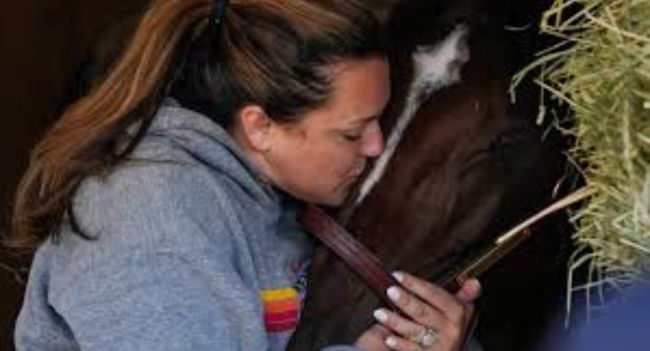
FROM DEAD LAST TO DERBY IMMORTALITY
For most of the race, Golden Tempo was nowhere near the conversation.
Buried at the back of the field, he looked like a statistical footnote in a race dominated by a heavy favorite and tightly controlled early pace. At multiple points, victory seemed mathematically out of reach.
But the Derby does not care about mathematics.
Turning into the final stretch, something shifted. What had been a quiet, invisible run suddenly turned into a violent surge through traffic, as Golden Tempo began slicing through horses with alarming precision and timing.
The crowd didn’t immediately understand what was happening — until it was too late.
A FINISH DECIDED BY A NECK — AND A FAMILY SPLIT IN REAL TIME
In the final moments, chaos overtook Churchill Downs.
Golden Tempo launched a late charge that carried him past the heavy favorite in a finish so tight it required confirmation at the wire. He won by a neck — barely measurable, impossibly dramatic.
Adding another layer to the moment, the race became an emotional collision for the Ortiz family: jockey José Ortiz guided Golden Tempo to victory while his brother Irad Ortiz Jr. rode the beaten favorite, turning the Derby finish into a rare sibling split at the highest level of the sport.
CHERIE DEVAUX BREAKS THE 152-YEAR BARRIER
While the finish belonged to the horse and jockey, the meaning of the moment belonged to Cherie DeVaux.
With this victory, she became the first woman in Kentucky Derby history to train a winner, breaking a record that had stood untouched since the race’s inception.
Her post-race words — “I’m just glad I don’t have to answer that question anymore” — carried the weight of years spent under scrutiny, skepticism, and repetition of the same doubt: whether a woman could ever win at this level.
Now, that question no longer stands.
A WIN YEARS IN THE MAKING — AND A MOMENT THAT REDEFINED EXPECTATION
What unfolded at Churchill Downs was not just a single race outcome. It was the culmination of a long, quiet ascent in a sport where breakthroughs rarely arrive gently.
DeVaux’s preparation, often outside the spotlight, finally collided with opportunity in a race that punished hesitation and rewarded precision under pressure.
Golden Tempo’s improbable path from last place to the winner’s circle became the physical expression of that journey — delayed, doubted, then delivered all at once.
A DERBY THAT WILL BE REMEMBERED FOR MORE THAN THE PHOTO FINISH
When the noise finally settled, three truths remained:
- A 23-1 outsider stole the race from dead last
- A heavy favorite was beaten in a neck-to-neck photo finish
- And history was permanently altered by a first-time female Derby-winning trainer
It was a race that did more than crown a winner — it challenged an entire narrative that had stood for over a century.
And yet, even now, insiders suggest there’s still one detail about the final moments that hasn’t been fully explained… something only a few people near the winner’s circle noticed, and it may change how this victory is remembered entirely.